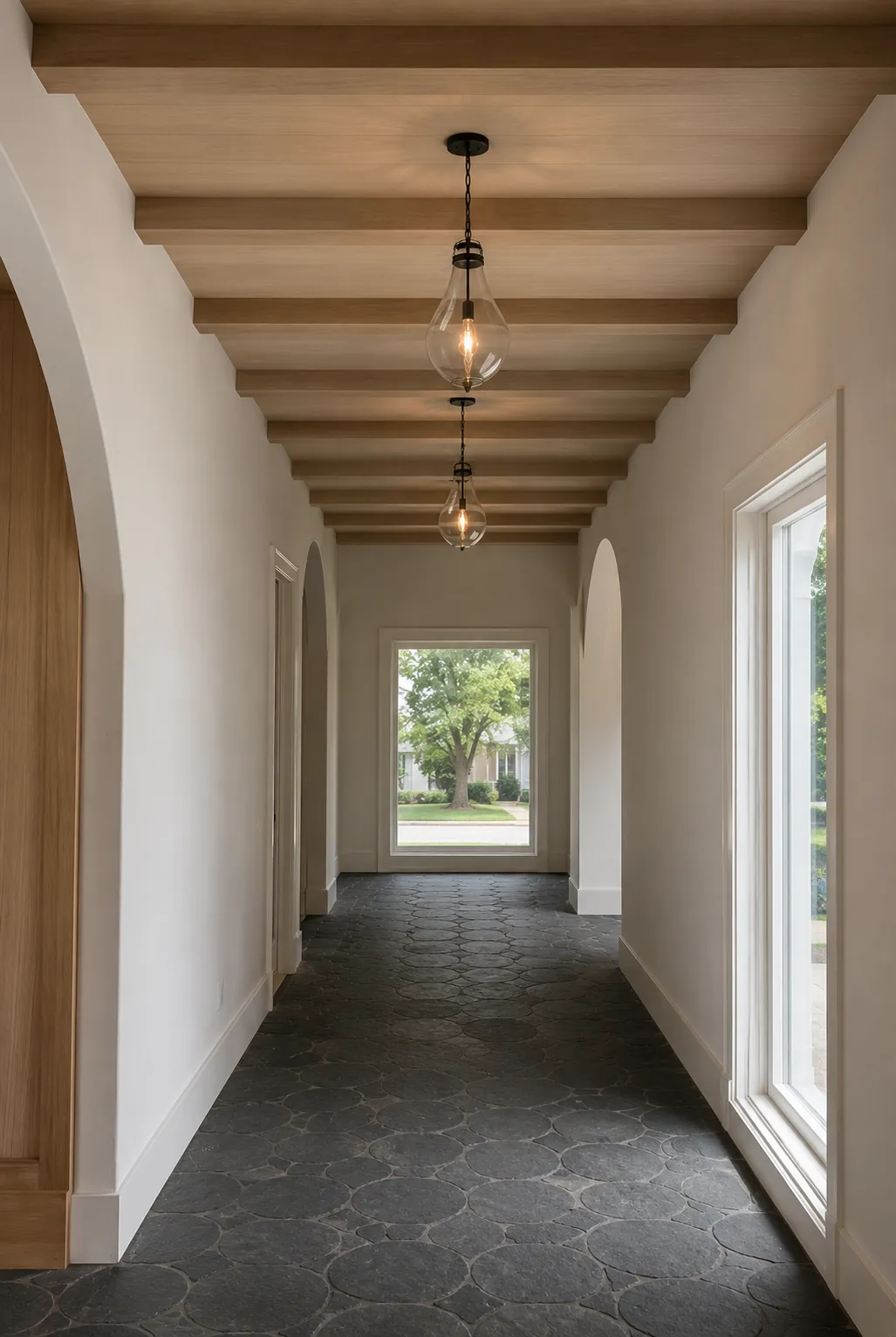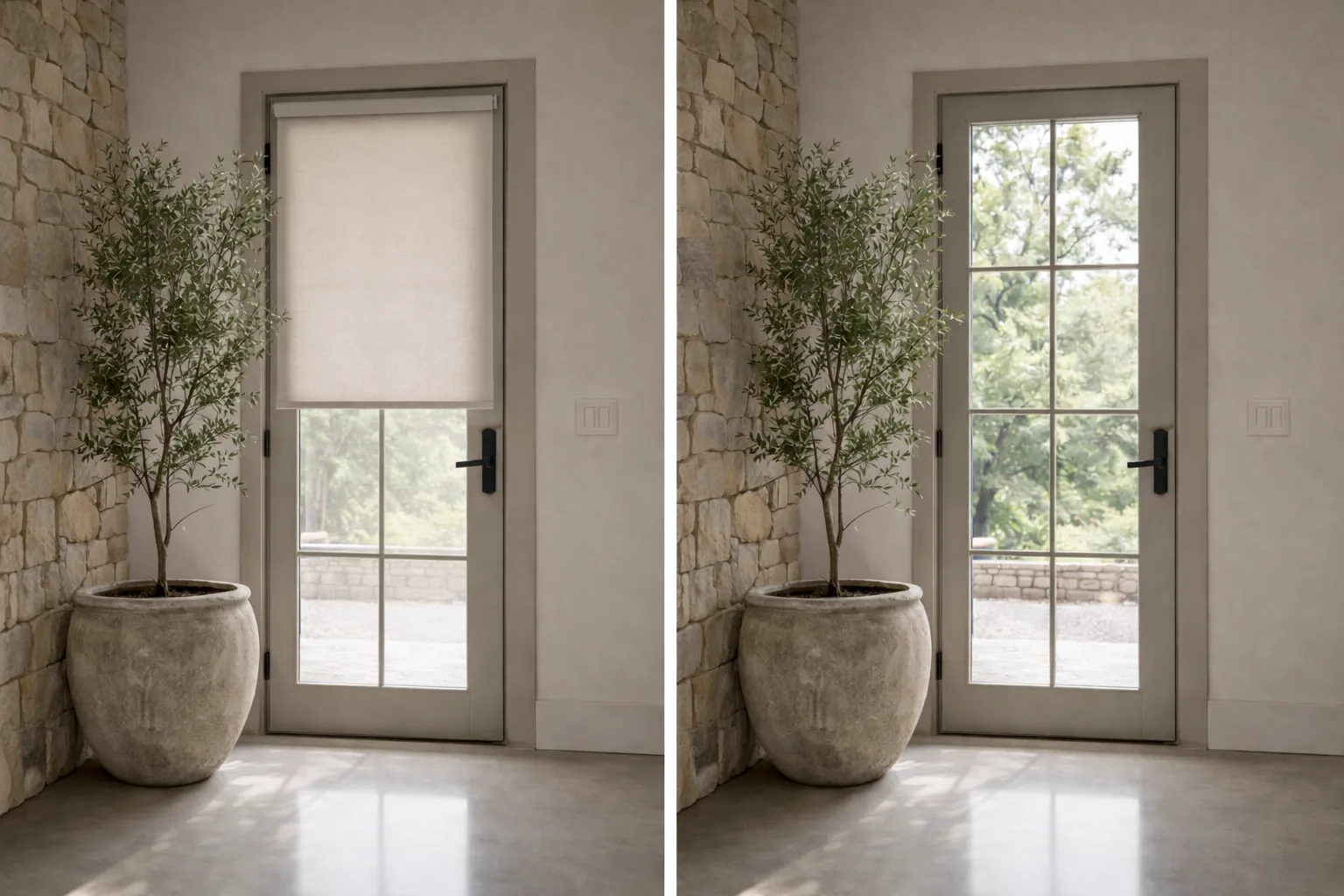
West facing glass on Lake Travis is the reason you bought the house, and the reason nobody sits in the living room at 5pm in July. Motorized shades solve that when they're specified for the window, the exposure and what actually happens in that room at sunset.
This guide covers the choices that matter most: fabric openness, color, power, controls, mounting and cost. The Shade Haus is the River Jane & Co. line of Roman and roller shades.
Why west glass on the lake is different
Afternoon sun comes in low, under the roof overhang, and the lake bounces it back up into the room. You get heat, glare on every screen and fading on floors, rugs and upholstery. Lake houses also tend to stack a lot of glass in one wall: tall windows, transoms and big sliders nobody can reach to pull a cord. That combination is exactly where motorized shades earn their price.
Solar shades and openness
Solar shades are woven screens that cut glare and heat while you keep a view through them. The big choice is openness, which is how tightly the fabric is woven. Common openings are 1, 3, 5 and 10 percent.
- Lower openness blocks more light and glare, and the view through it is dimmer.
- Higher openness keeps more of the view and lets in more light and heat.
For west facing lake glass, around 5 percent openness is a good starting point. You can usually still see the water at sunset without squinting. The right number depends on your glass, your exposure and how bright you like the room, so look at samples in the window at the hour the sun is worst before you commit.
Fabric color matters as much as openness. Darker fabrics generally give a clearer view through the weave and cut glare better. Lighter fabrics reflect more heat and brighten the room, but they can glow when the sun hits them. A good rule: pull the color from the window frames or the wall, so the shade disappears when it's down.
When a Roman shade is the better answer
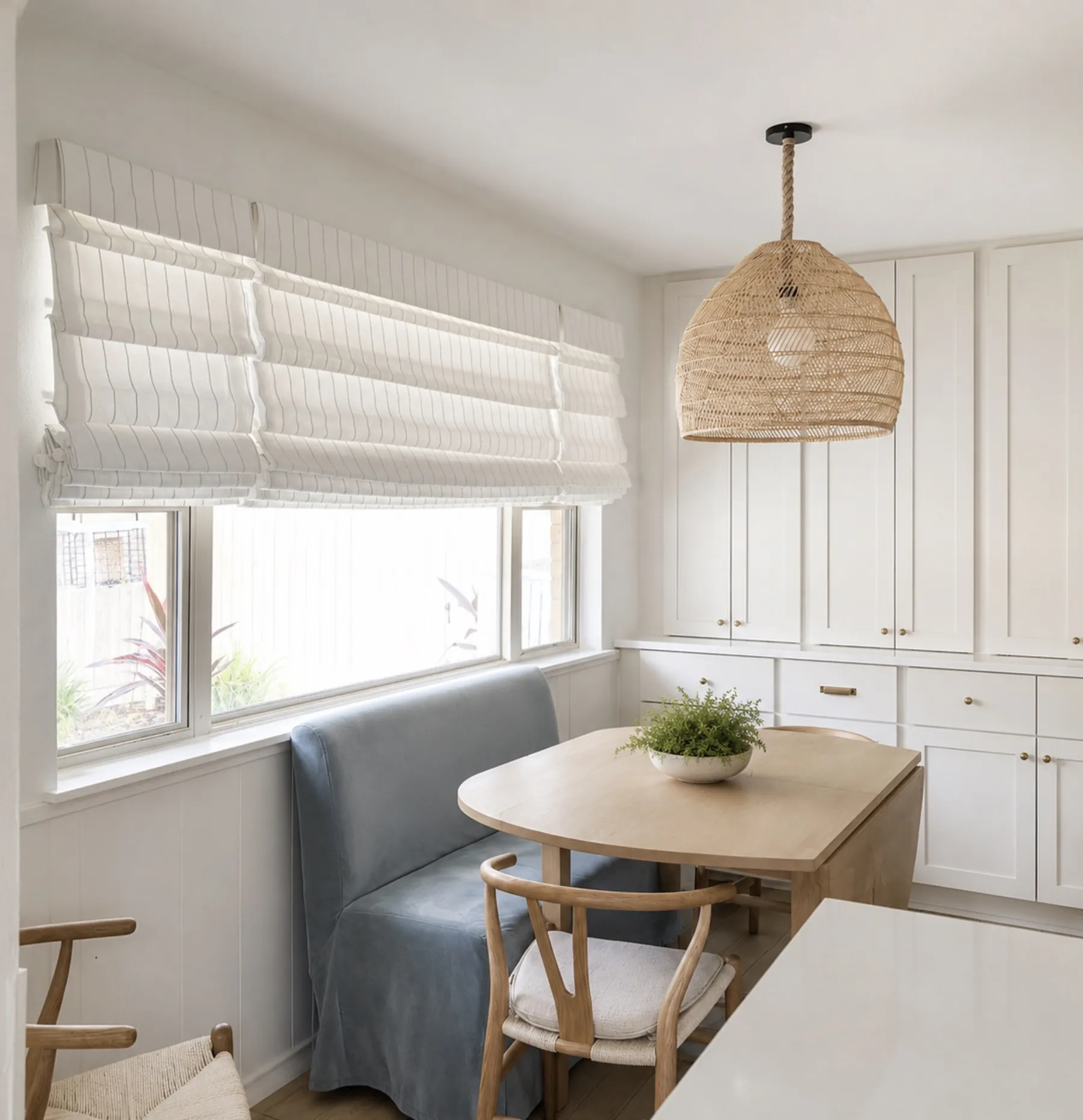
Not every window wants a solar shade. Bedrooms need privacy and darkness, kitchens and breakfast nooks often want texture, and a small window doesn't need a motor. Woven wood Romans bring warmth to big kitchens and great rooms, and linen Romans soften a room and its drywall returns. Roman shades can be motorized too, depending on the material and the size. Cordless shades from The Shade Haus start at $299 a window, and motorized shades start at $399 a window.
A smart mix for a lake house: solar shades on the west glass for the afternoon, Romans in the rooms where you want softness or privacy.
Dual shades for day and night
A dual shade puts two fabrics on one window: a solar screen for daytime and a privacy or room darkening fabric for evening. It's a clean fix for a west window in a bedroom, or a living room that faces the water where boats pass after dark. The Shade Haus offers dual shades, so you don't have to pick one job for the window.
Power: hardwired or battery
Motors need power, and there are two ways to get it.
Hardwired motors run on power brought to each window. It's the cleanest option and there's nothing to charge. The wiring goes in while the walls are open, and hardwired motors need an electrician, so plan them for a new build or a major remodel, ideally before drywall.
Battery and rechargeable motors need no new wiring, which makes them the practical pick in an existing home. The tradeoff is recharging or swapping batteries on a schedule. A tall window that's a pain to reach is a good argument for hardwiring, if you can get power to it.
Control, schedules and privacy
Shades can run from an app, a wall remote or a handheld remote, and they can follow a schedule tied to the sun. On west glass the schedule is the whole point: the shades come down as the sun swings around and go back up after it sets, whether anyone's home or not. That also protects floors and furniture in a house that sits empty during the week.
One thing people don't expect: solar shades give daytime privacy, but at night, with lights on inside, anyone outside can see in. If a room faces a neighbor or a busy stretch of water, pair the solar shade with a Roman or a room darkening shade for evenings, or go with a dual shade.
West glass giving you trouble?
Book a shade consultationMounting, pockets and measuring
Shades mount inside the window opening or on the wall outside it, and motorized shades can hide in a ceiling pocket or behind a fascia. Pockets and extra blocking are easy to add during construction and hard to add later, so if you're building, raise it with your builder early.
Before you choose an inside mount, measure the depth of the window opening. A motor headrail needs more room than a cordless shade, and a shallow frame can push you to an outside mount. Check for window cranks, handles and alarm sensors that could get in the shade's way, and wait until the windows are in before anyone takes final measurements.
What motorized shades cost
Cordless shades from The Shade Haus start at $299 a window, and motorized shades start at $399 a window. The final price depends on the fabric and the controls you choose, and every window is quoted in writing before anything is ordered, so you can see exactly what each opening costs.
What to ask before you buy motorized shades
- Can I see the fabric in my own window at the worst hour of the day?
- Who takes the final measurements, and who's responsible if a shade arrives the wrong size?
- Is each motor hardwired or battery, and why for this window?
- How do the controls work, and can they run on a sun schedule?
- What's the warranty on the motor and the fabric, and who do I call if something stops working?
Get the answers in writing, window by window. The Shade Haus makes Roman and roller shades, including dual shades, and doesn't do drapery.
Motorized shades around Lake Travis and Austin
River Jane & Co. works within about 28 miles of its Spicewood studio, Austin included on the same terms. That covers the west side of the lake in Spicewood and Lago Vista, the water around Lakeway and Hudson Bend, and Bee Cave and West Lake Hills closer to town. For more on what west light does to a room, read designing a lake house on Lake Travis.