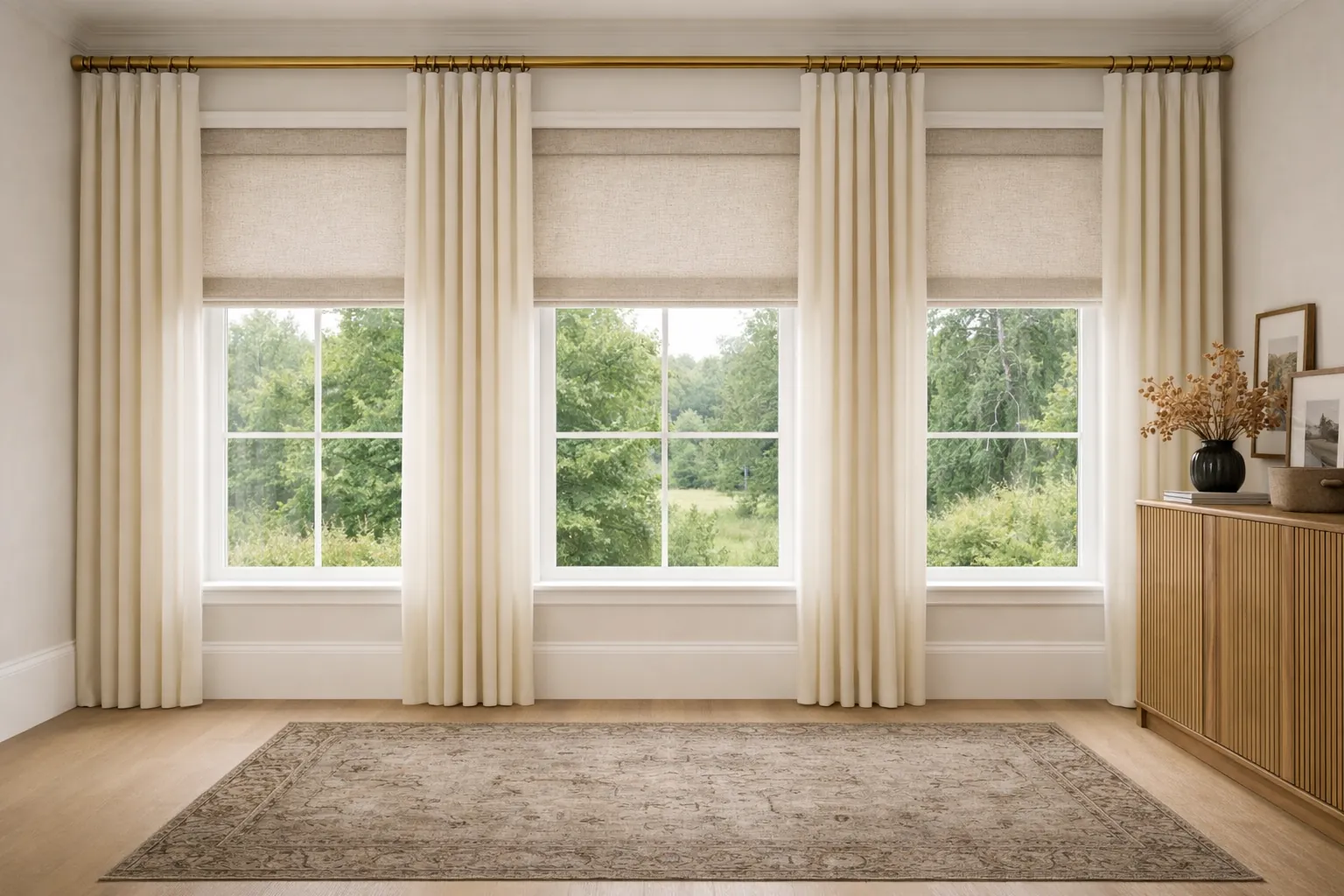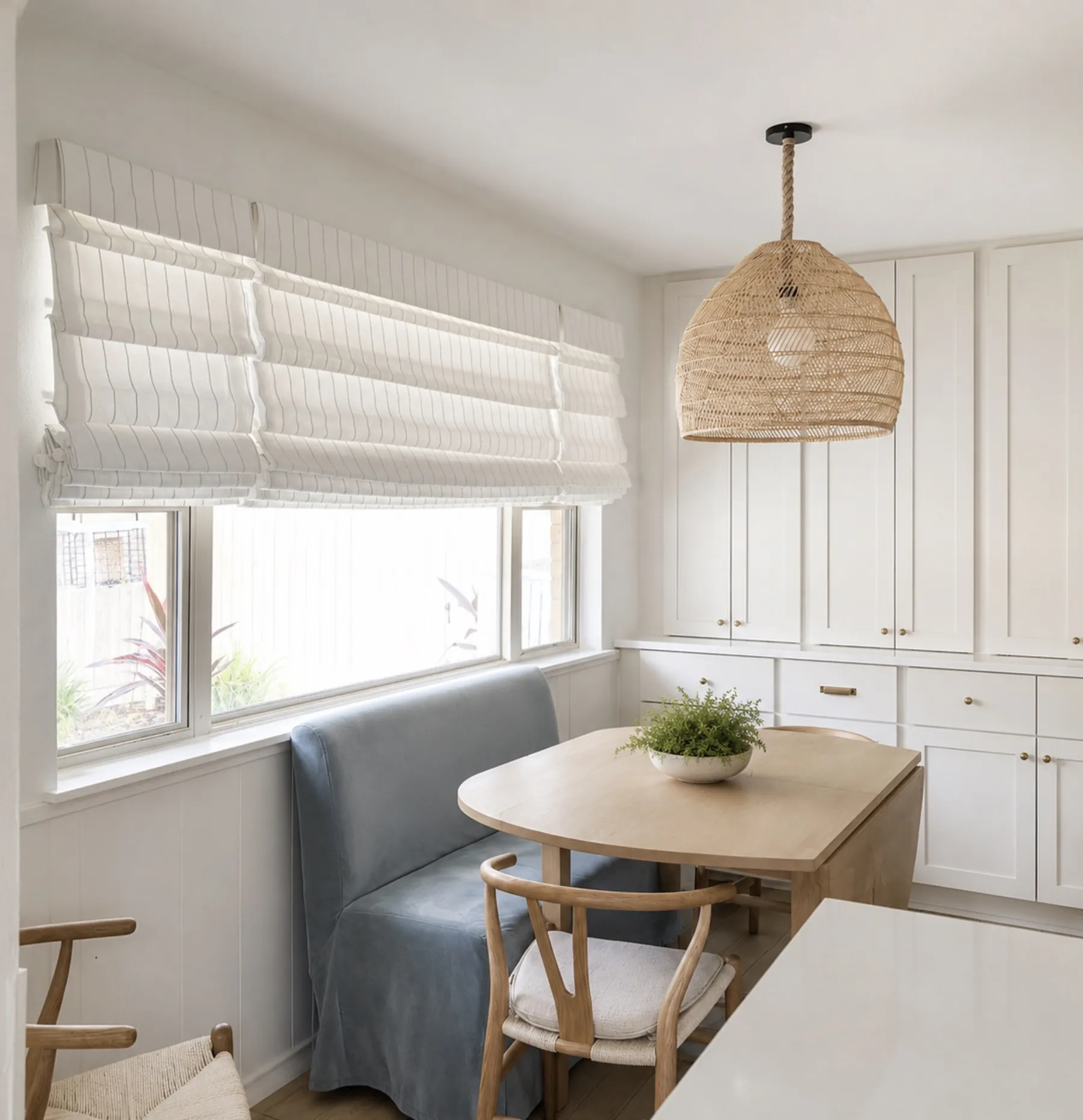
Cordless Roman shades are fabric shades that fold up and down with no pull cords. A spring system in the headrail holds the shade wherever you leave it: lift the bottom rail to raise it, pull the rail down to lower it. They look cleaner than corded shades, they're safer around kids and pets, and they suit almost any window you can reach from the floor.
The Shade Haus is the shade line from River Jane & Co. Cordless Romans start at $299 a window, and motorized Romans start at $399 a window, depending on fabric and controls. This guide covers how they work, fold styles and linings, fabric by room, how to measure, and where cordless stops making sense.
How do cordless Roman shades work?
A traditional Roman lifts on cords that run through rings on the back of the fabric and out the side of the headrail. On a cordless Roman, those lift cords stay hidden inside the shade and wind onto a spring in the headrail. The spring is balanced to the weight of the fabric, so the shade stays put at any height.
- To raise it, hold the center of the bottom rail and push up. The folds stack as the shade rises.
- To lower it, pull the bottom rail down gently and let go where you want it.
- To keep it working, always lift from the center. Lifting from a corner throws the folds out of line.
Some cordless Romans also come as top down bottom up, so the shade can drop from the top to let light in over the window while the bottom stays covered. It's a great pick for bedrooms and baths that face a street or a neighbor.
Why go cordless?
Safety. Loose window cords are a strangulation hazard for young children, and the Consumer Product Safety Commission recommends cordless window coverings in any home with small kids. It keeps curious cats and dogs out of trouble too.
A cleaner window. No cords hanging down the side, no cleats screwed into the trim, nothing to tangle. The shade reads as fabric and nothing else.
Easy everyday use. One hand, one motion. There's no cord to find or lock, and the shade stops right where you leave it.
Budget. Cordless is the most affordable way to get a custom Roman with no cords. A motor adds the motor, the power and the controls, so on windows you can reach easily, going cordless leaves more room in the budget for better fabric or a lining.
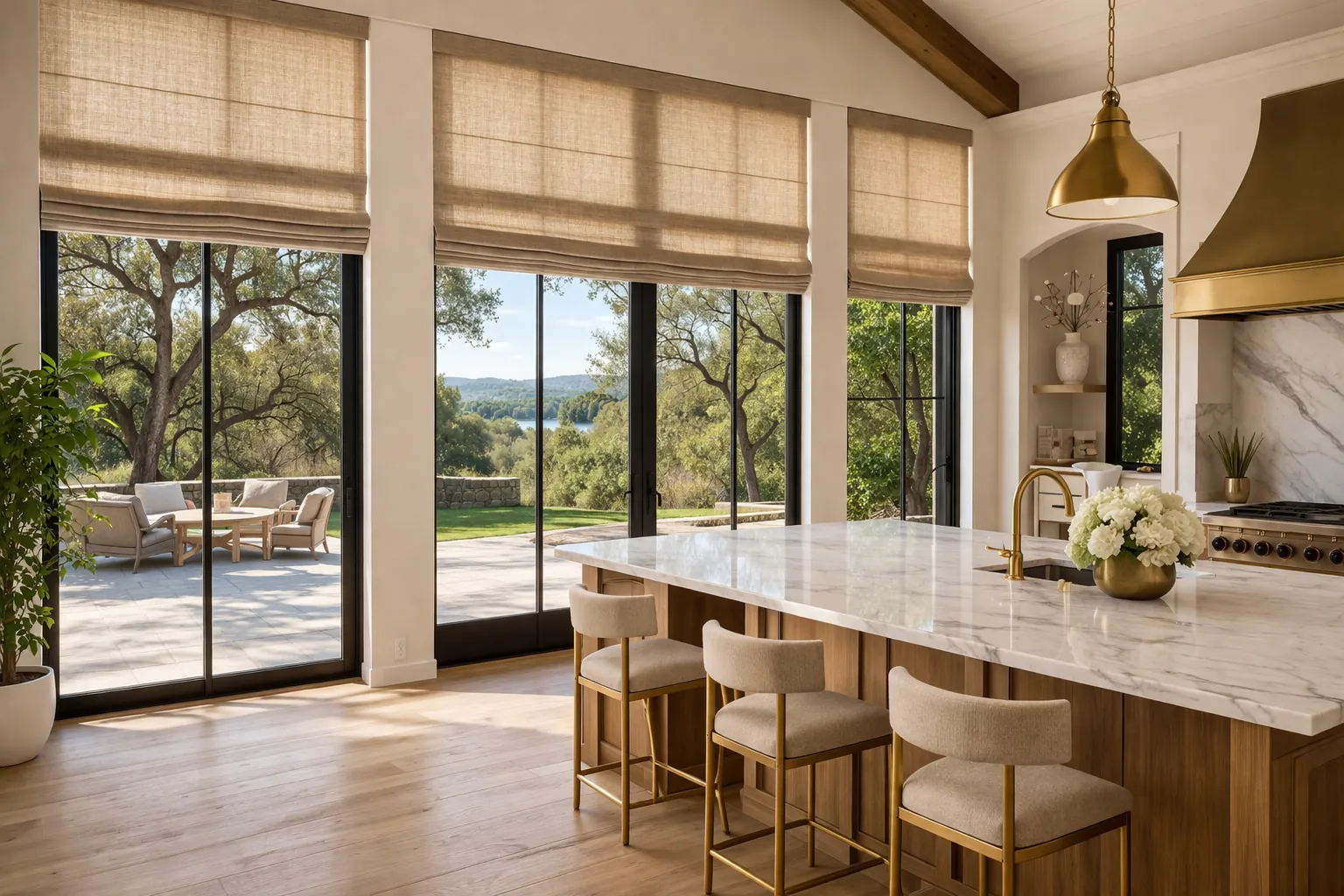
Flat, hobbled and relaxed folds
Every fold style can be made cordless. Pick the one that suits the room and the fabric.
- Flat fold lies smooth when lowered and stacks in crisp pleats when raised. The most tailored option, and the best way to show off a pattern.
- Hobbled keeps soft, overlapping loops down the whole shade. Fuller and more traditional, and it uses a lot more fabric, which shows up in the price.
- Relaxed is flat with a gentle curve at the bottom edge. Casual and soft. It looks best on narrower windows, where the curve reads as a choice.
Linings and light control
- Unlined for a soft glow and lots of texture, with little privacy at night.
- Privacy lining to block the view in, give the folds more body and protect the face fabric from sun.
- Blackout lining for bedrooms and media rooms. Expect a little light at the edges, and mount outside the frame where a room needs to be truly dark.
- Interlining for a fuller, heavier fold and a bit of extra insulation.
In Texas sun, a lining is worth it on almost any linen or cotton Roman. It slows fading on the face fabric and keeps the shade looking the same from the street.
The best fabric for Roman shades, room by room
- Living rooms and bedrooms. Linen, linen blends, textured weaves and patterns. This is where the fabric gets to be the star.
- Kitchens. Durable blends and performance fabrics that clean easily, kept well clear of the range. Woven woods over a sink add texture and filtered light.
- Baths. Fabrics and linings that handle humidity, mounted out of the splash zone. A really steamy bath may do better with a moisture resistant roller.
- Lake and west facing rooms. Lined fabrics that stand up to strong sun, in colors that won't show fading fast.
Always judge a sample in the window where the shade will hang, morning and late afternoon. A linen that looks warm under store lights can turn gray in north light and yellow in west light. For more on fabrics that hold up to lake life, read designing a lake house on Lake Travis.
Where cordless Romans reach their limits
Cordless works for most windows. A few need something else.
- Tall windows. If you can't reach the bottom rail when the shade is up, you can't lower it. Transoms, stair windows and two story glass need a motor.
- Very wide or heavy shades. A big Roman in a heavy, interlined fabric gets hard to lift by hand, and every product has maximum sizes. Split a wide opening into two or three shades, or motorize it.
- Windows behind furniture. A shade over a deep counter, a tub or a built in bench can be a stretch to reach. Motorize it or rethink the mount.
- Lots of windows in one room. Walking around to lift eight shades gets old fast. A motor on a group of shades fixes it.
Roman shades can be motorized, depending on the fabric, the size and the product. See motorized shades in Austin for the options and are motorized shades worth it for the cost side.
How to measure for Roman shades
Start by deciding between an inside mount and an outside mount, because you measure differently for each.
- Check the depth first. An inside mount needs enough flat depth in the window frame for the headrail. Too shallow, and the shade sticks out or won't fit at all.
- Inside mount width. Measure across the top, middle and bottom of the opening and use the smallest number. Old frames are rarely square.
- Inside mount height. Measure left, center and right, from the top of the opening to the sill.
- Outside mount. Add a few inches on each side for better coverage and less light at the edges, and decide how high above the frame the headrail goes.
- Plan for the stack. A raised Roman stacks at the top. Mount it higher than the frame and the stack sits above the glass, so you keep the whole view.
- Look for obstructions. Window cranks, lever handles, alarm sensors and trim all change what fits.
Every window is quoted in writing from its size, fabric, fold style, lining and control, so the details above matter before anything is ordered.
Care and cleaning
Dust Roman shades often with a soft brush attachment on low suction, working with the folds. Spot clean spills gently with a damp cloth, testing a hidden spot first. Most lined and interlined Romans aren't washable, so follow the fabric's care code and use a professional cleaner for anything bigger than a spot. Woven woods just need dusting. If a cordless shade starts to creep or won't hold its position, the spring tension usually needs adjusting. Get that looked at before you force it.
Are Roman shades still in style?
Roman shades have outlasted most window trends because they're simply fabric, folded well. The current look is flat folds, natural linens, warm whites and soft neutrals, woven woods and a simple contrast band. They suit the relaxed, natural rooms going into homes around Austin and Lake Travis, and they don't date the way heavy valances did.
Picking Roman shades for a nook, bedroom or kitchen?
Book a shade consultationWhat cordless Roman shades cost at The Shade Haus
Cordless Roman shades start at $299 a window, and motorized Romans start at $399 a window. The price of each shade moves with its size, fabric, fold style, lining and control, and every window is quoted in writing. It starts with a free 15 minute call, then a consultation, in your home or virtual.
Roman shades around Austin and Lake Travis
See Romans in finished rooms in the window treatment portfolio, and every fold, lining and fabric option on the Roman shades page. The Shade Haus works with homes within about 28 miles of the River Jane & Co. studio in Spicewood, from Austin, West Lake Hills and Bee Cave to Lakeway, Horseshoe Bay and Marble Falls.