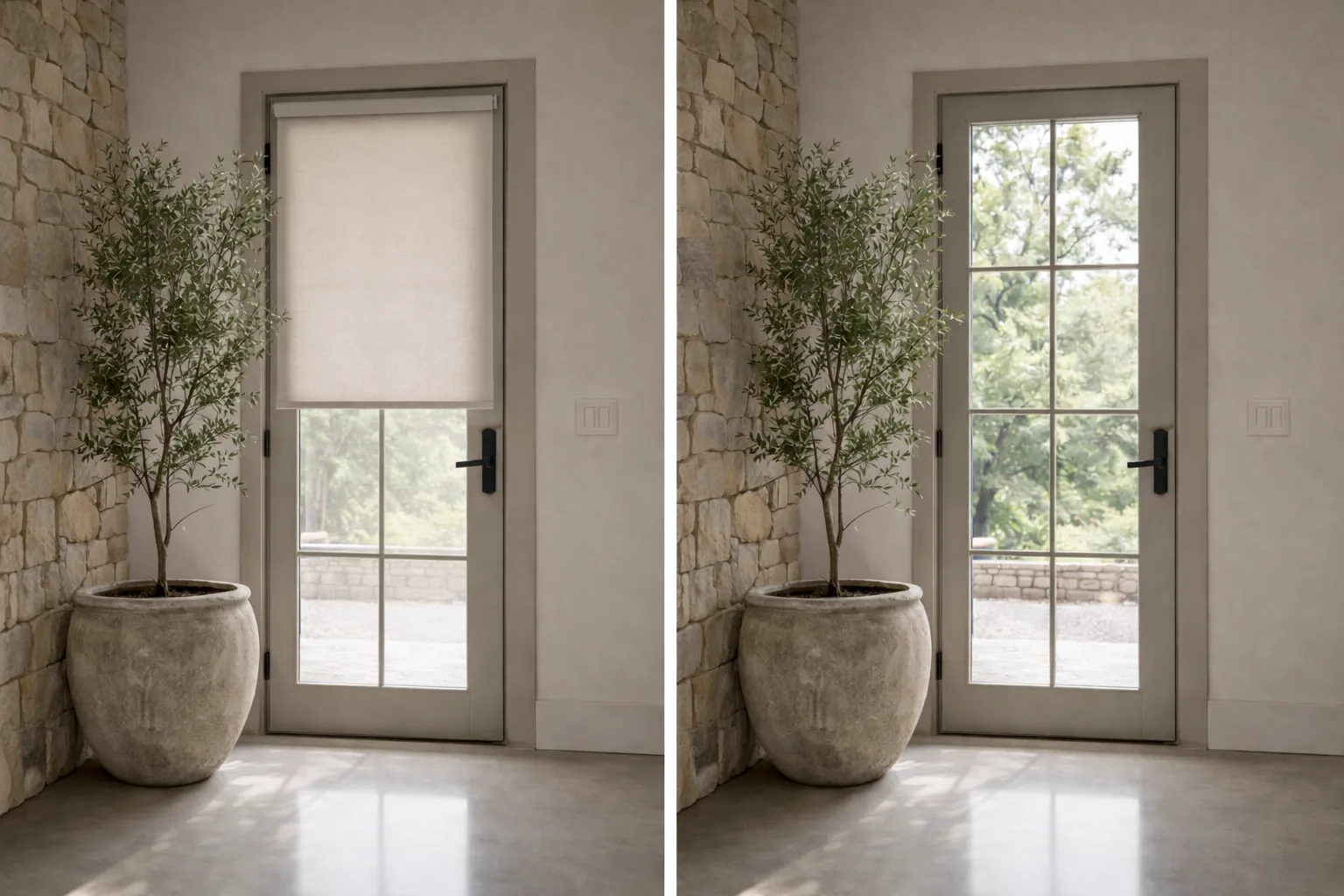
Roller shades are a single panel of fabric that rolls up onto a tube at the top of the window. They're the cleanest, most flexible shade there is. The Shade Haus is River Jane & Co.'s shade line, with custom roller and solar shades for homes in Austin, Lake Travis and the Hill Country. Cordless rollers start at $299 a window and motorized rollers at $399, depending on fabric and controls. It starts with a free 15 minute call, and every window is quoted in writing before anything is ordered.
The same simple shade can keep a lake view while cutting afternoon glare, black out a bedroom, or do both on one window. The fabric, the openness and the mount decide which.
Three kinds of roller shade
- Solar or screen shades. An open weave that cuts glare, heat and UV while you still see out. The go to for living rooms, kitchens and offices with a view.
- Light filtering. A solid fabric that lets soft light through with no view in or out. Good for street facing rooms, bathrooms and anywhere you want privacy during the day.
- Room darkening and blackout. Opaque fabrics for bedrooms, nurseries and media rooms.
Each comes in a wide run of colors and textures, from smooth to linen-look weaves, so a roller can feel as soft as the rest of the room.
Solar shades and openness
Solar shades are sold by openness, the share of the weave that's open. The common options are 1, 3, 5 and 10 percent.
- 1 percent blocks the most glare and heat. The view through is dimmer, which suits media rooms and hard west sun.
- 3 percent is a solid balance for living spaces that take direct afternoon light.
- 5 percent keeps more of the view and still takes the glare off screens. It's a strong starting point for west-facing lake glass.
- 10 percent keeps the most view and light, for rooms with softer sun.
Color matters as much as the number. Darker fabrics usually give a clearer view out and handle glare better. Lighter ones bounce more heat back out through the glass and brighten the room, but they can glow when the sun hits and the view gets hazier. Hold samples in the window at the hour the sun is worst before you pick. The full story on lake glare is in motorized shades for west facing lake views.
Solar fabrics also cut UV, which is what fades floors, rugs and upholstery. A rough rule: a solar fabric blocks about the share of UV that isn't open, so a 3 percent fabric blocks around 97 percent of it. With Austin sun as strong as it is most of the year, that protection is reason enough to put solar shades on windows with no view at all.
One catch surprises people. Solar shades give privacy during the day, when it's brighter outside. At night with the lights on, people outside can see in. A room that faces neighbors or passing boats needs a second layer.
Blackout roller shades
A blackout fabric stops light through the shade itself, but every roller leaves small gaps at the sides and top. How dark the room gets depends on the mount:
- Inside mount looks cleanest and leaves the most light at the edges.
- Outside mount, overlapping the frame by a few inches on all sides, cuts most of the gap and gets closest to dark for nurseries and media rooms.
- A fascia or cassette at the top hides the roll and blocks the light that spills over it.
The Shade Haus doesn't offer side channels, so for a really dark room, an outside mount with a generous overlap is the move.
Dual shades
A dual shade puts two rollers on one bracket, usually a solar shade in front and a blackout behind. Lower the solar in the afternoon for glare and the blackout at night for privacy and sleep. It fixes the nighttime privacy gap of a solar shade without adding a second treatment to the wall. Dual shades are a great fit for primary bedrooms on the lake and for great rooms that double as media rooms. Each shade can be motorized on its own.
Roller shades for kitchens, baths and offices
Rollers are the practical pick anywhere a shade has to work hard. Over a kitchen sink or a breakfast table, a light filtering or solar roller stays out of the way and wipes clean. In a bath, a moisture resistant roller handles steam better than most Roman fabrics, and a light filtering fabric keeps the room private and bright. In a home office, a low openness solar shade takes the glare off the screen and keeps the daylight. Because rollers stack so small at the top, they also fit where there's little room above the window, like under a low soffit or a beam.
Motorized roller shades
Rollers are the easiest shade to motorize. A tubular motor slides inside the roller tube, out of sight, and runs from a remote, a wall keypad, an app, a voice assistant or a sun schedule. Power can be battery, rechargeable or hardwired, and hardwired motors need an electrician to run power to each window. Motorized rollers start at $399 a window. They're the obvious choice for tall glass, big sliders and rooms where several shades need to move together. The options are covered on motorized shades in Austin, and the cost question in are motorized shades worth it.
Mounting and hardware
A roller can hang with the roll showing, or with a fascia, valance or cassette in front. On a new build, a ceiling or header pocket hides the shade completely when it's up. That pocket is easy to frame before drywall and hard to add after, so bring it up with your builder early if you're working on a new build. The bottom rail can be exposed or wrapped in the same fabric. A reverse roll, where the fabric drops off the front of the tube, can clear a door handle or a window crank.
Roller shades or Roman shades?
Plenty of houses use both. Rollers suit large glass, sliders and anywhere the view is the point, since they nearly disappear when raised and work with solar fabrics. Romans suit rooms that want softness and texture, like bedrooms, breakfast nooks and kitchens with a smaller window. See Roman shades in Austin for fold styles and fabrics.
What drives the cost of roller shades
- Size. Wider shades need heavier tubes, and very wide openings may be split into two or three shades.
- Fabric. Solar, light filtering and blackout fabrics are priced differently, and so are designer weaves.
- Control. Cordless or motorized, and for motors, battery or hardwired.
- Hardware. Fascias, cassettes and dual brackets.
- The whole house. Planned together, shades line up at the same heights and fabrics repeat from room to room.
Your written quote lists each window with its fabric, control and hardware, so you can see where the money goes before you approve anything.
Glare on the screens every afternoon?
Book a shade consultationHow to choose roller shades
- 01
Match the fabric to the room
Solar for glare with a view, light filtering for daytime privacy, blackout for sleep. A room that needs two of those gets a dual shade.
- 02
Pick openness and color
For solar fabrics, choose 1, 3, 5 or 10 percent openness, then the color. Hold samples in the glass at the worst hour of sun before you decide.
- 03
Choose mount, hardware and control
Measure the window depth for an inside mount, or go outside the frame for a darker room. Add a fascia or cassette to hide the roll, then decide cordless or motorized.
- 04
Get it quoted in writing
Every window is quoted in writing, with fabric, openness, mount, hardware and control listed line by line, before anything is ordered.
Common mistakes to skip: choosing solar openness from a photo, picking a light fabric for west glass without checking the glow, and forgetting that solar shades don't give privacy at night. If you're redoing the room too, the shades can be planned inside a Design Strategy.
Roller and solar shades in Austin and Lake Travis
River Jane & Co. is based in Spicewood and works within about 28 miles of the studio, with Austin included on the same terms. That covers Lakeway and the rest of Lake Travis, Bee Cave, West Lake Hills, Spicewood, Horseshoe Bay, Marble Falls and Austin. See the full list of areas, and every shade at The Shade Haus.